
Gym Flooring Buying Guide for Commercial Facilities
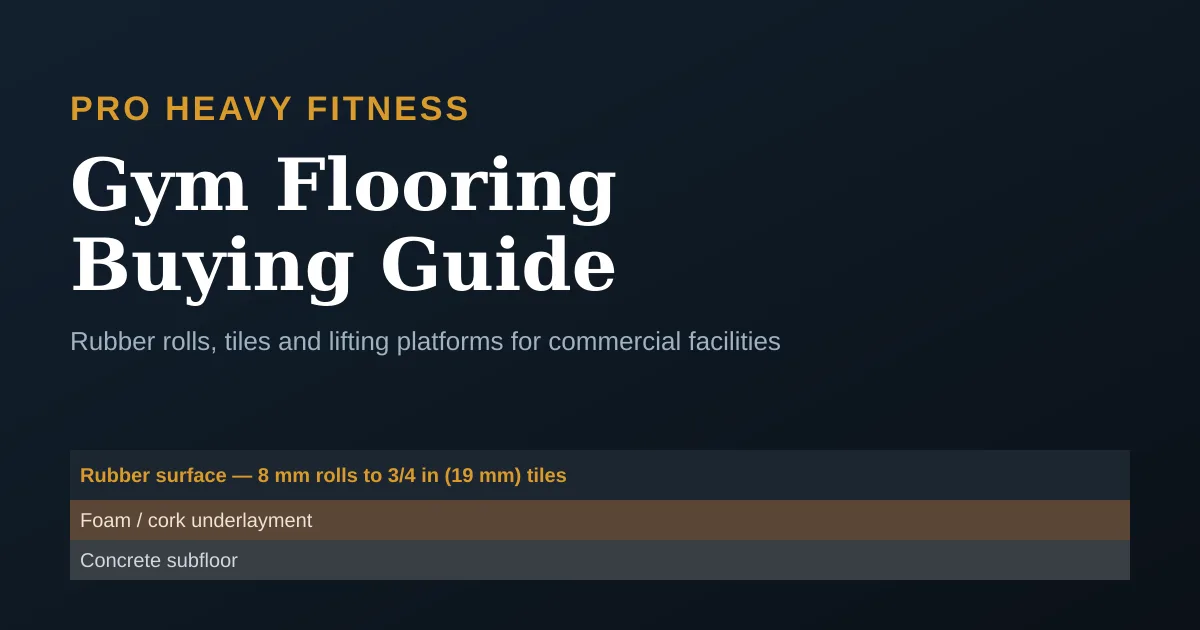
This gym flooring buying guide helps fitness facilities choose the right floor from three options: rubber rolls, interlocking tiles, and foam mats. Each surface changes how a gym handles equipment loads, impact, and noise, so the choice comes down to thickness, shock absorption, and subfloor prep by training zone. The short version: match floor thickness to the heaviest load a space will ever see, whether that is cardio machines or a lifting platform.
What Commercial Gym Flooring Has to Do
Gym flooring protects three things at once: the concrete slab beneath it, the equipment set on top of it, and the people training on it. In a facility that sees heavy free weights, dropped loads can exceed several hundred pounds of impact, so the floor has to absorb shock, deaden noise, and resist compression without cracking, all of which shapes training performance. A home mat rated for light workouts will not survive that duty cycle.
Function drives every other choice in this guide. A cardio and machine gym floor mostly needs a durable, easy-to-clean surface with light cushioning. A strength or lifting space needs real impact absorption and a stable, level surface so barbells do not bounce unpredictably. Group-fitness and turf zones sit somewhere between. Before comparing products, map your facility by zone and by the heaviest weight each zone will handle. Different zones host different exercises, so consider what each space is designed to do before you choose — that is the important first step — that single decision sets depth, material, and installation method for the whole space.
Rubber dominates commercial gyms because it is dense, resilient, and forgiving. Most rubber used in gyms is made from recycled vulcanized natural and synthetic rubber reclaimed from scrap tires, which is why it handles repeated impact and heavy foot traffic far better than foam.
Rubber Rolls vs Interlocking Tiles vs Foam Mats
Rubber rolls give the most continuous, permanent surface for large open floors; interlocking rubber tiles trade a few seams for easy installation and repair; foam mats suit only light, low-impact zones. Choose by traffic, load, and how permanent the install needs to be.
These three surface types cover almost every gym layout. The mechanism that separates them is how load and wear travel across the floor. Rolls spread it across a single continuous sheet, tiles rely on interlocking edges to hold a grid together, and foam simply is not dense enough to carry heavy point loads.
| Flooring type | Ideal commercial use | Install method | Trade-off |
|---|---|---|---|
| Rubber rolls | Large open training floors, cardio and machine areas | Rolled out, seams glued or double-sided taped | Heavy to handle; fewer seams but harder to replace a single spot |
| Interlocking rubber tiles | Weight rooms, spaces that need staged install or future changes | Puzzle-edge tiles snap together, no adhesive needed | More seams; a damaged tile swaps out in minutes |
| Foam mats | Stretching, bodyweight, kids or rehab zones | Interlocking foam squares, loose-lay | Compresses under heavy equipment; not for free weights |
For most free-weight and functional-training floors, dense rubber — whether in rolls or interlocking tiles — is the durable option. Foam earns its place only in low-impact areas. Interlocking tiles are the practical choice when a facility wants to install in phases, move equipment later, or replace a worn section without redoing the whole floor.
How Thick Should Gym Flooring Be
Thickness scales with impact. Cardio and machine areas work at 6–8 mm (1/4–3/8 in), general free-weight floors at 3/8–1/2 in (8–12 mm), and dedicated lifting or drop zones at 3/4 in (19 mm) or more. Under-speccing is the most common and most expensive mistake.
Thickness is where shock absorption actually comes from. A thin surface transmits impact straight through to the slab and back up into the barbell and the lifter; a thicker rubber layer absorbs and dissipates that energy. It also controls noise, which matters in multi-tenant buildings and shared facilities.
| Training zone | Typical thickness | What it handles |
|---|---|---|
| Cardio & selectorized machines | 6–8 mm (1/4–3/8 in) | Foot traffic, static equipment, light cushioning |
| General free-weight floor | 3/8–1/2 in (8–12 mm) | Dumbbells, moderate loads, machine bases |
| Lifting / drop zones | 3/4 in (19 mm) or thicker | Loaded barbells, deadlifts, controlled drops |
The dimensions above reflect common product conventions, not fixed rules. When a space serves mixed use, spec to the heaviest activity it will ever host rather than the average — it is far cheaper to over-spec depth once than to tear up and replace a floor that failed under load.
Flooring for Lifting Platforms and Heavy Lifting Areas
Dedicated lifting demands more than thick rubber. A lifting platform pairs a rigid center for stable foot contact with rubber landing zones that absorb dropped loads, all sitting on a level subfloor. This is the one zone where thickness and structure both matter.
In a heavy lifting area, the surface does two competing jobs. Under the lifter’s feet it needs to be firm and level so the base of support does not shift mid-lift. Where the loaded barbell lands, it needs to absorb a fast, concentrated impact. That is why a purpose-built platform uses a hard, stable center flanked by thick rubber landing strips, rather than one uniform layer. The National Strength and Conditioning Association treats stable, appropriate flooring as part of safe resistance-training facility design.
Under any heavy zone, the subfloor decides how well the system works. Rubber absorbs impact, but it cannot fix an uneven or soft base. A flat, solid concrete subfloor is the reference standard; over wood or suspended floors, a facility usually adds a rigid underlayment first so the platform stays level and the structure below is protected. If you are building out a full institutional weight room, our team can help spec platform and flooring together — see our commercial and B2B facility sales page for how that process works.
Installation, Subfloor Prep and Maintenance
Good gym flooring is only as good as its install. Level and clean the subfloor first, choose glued rolls for permanence or interlocking tiles for flexibility, and keep the surface with routine dry and damp cleaning. Most premature floor failures trace back to skipped subfloor prep.
Installation method follows the material. Rubber rolls are rolled flat and either double-sided taped for a semi-permanent floor or fully glued for a permanent one; seams are butted tight and, in wet or high-traffic areas, sealed. Interlocking tiles need no adhesive — the puzzle edges hold the grid together, which is what makes them easy to install in stages and simple to repair. In both cases the base must be clean, dry, and level before anything goes down; debris or high spots telegraph straight through the finished surface.
Keeping the floor in service
Maintenance on commercial rubber is straightforward, which is part of its durability advantage. Dry-sweep or vacuum daily to pull grit that would otherwise abrade the surface, then damp-mop with a pH-neutral cleaner on a regular cycle. Avoid harsh solvents, which can degrade rubber over time. Well-maintained rubber gym flooring routinely lasts many years of heavy use, and interlocking tiles let you replace a single damaged square instead of the whole floor — a real cost advantage over its service life.
How to Choose Gym Flooring for Your Facility
Work backward from your heaviest zone. Pick the material by traffic and load, set thickness by impact, choose rolls or tiles by how permanent and how repairable you need the floor to be, then confirm the base slab can carry it. Those four decisions define the right floor.
The decision is a short sequence, not a single pick. Facilities get into trouble when they choose by price per square foot first and specification second. The table below turns the sequence into a quick reference by facility type.
| Facility profile | Surface | Thickness starting point | Why |
|---|---|---|---|
| Cardio / machine studio | Rubber rolls | 6–8 mm | Continuous, easy to clean, light cushioning |
| Mixed commercial gym | Rolls or interlocking tiles | 3/8–1/2 in | Balances durability with future flexibility |
| Strength / CrossFit-style box | Interlocking tiles + platforms | 3/4 in in drop zones | Impact absorption plus easy section repair |
| Institutional / school weight room | Rubber tiles + dedicated platforms | 3/4 in or thicker in lifting areas | Heavy use, safety, and long service life |
Pro Heavy Fitness is a US commercial-equipment specialist that launched in 2025, and we spec flooring the same way we spec racks and machines — to the real duty cycle of your space, not a catalog average. Because this is a high-ticket, install-sensitive purchase, we quote through a person rather than a cart: you can start on our commercial equipment shop and reach the team for a floor-and-platform spec. Financing and price-match options are covered on our financing page.
What Gym Flooring Costs Over Its Service Life
Gym flooring price is driven by four things: material, thickness, total square footage, and installation method. The lower-cost surface is rarely the cheaper decision over a floor’s service life, because a floor that fails under load has to be removed and replaced — twice the labor for one result.
For a facility, flooring is a capital purchase, so the number that matters is cost over years of service, not price per square foot on day one. Four factors move the figure. Material sets the floor: dense recycled rubber costs more than foam but carries heavy loads foam cannot. Thickness adds material cost but is what protects the subfloor and the equipment. Square footage scales the total, and zoning — thicker rubber only where lifting happens — keeps it in check. Installation is the last driver: glued rolls cost more labor up front than loose-lay interlocking tiles, but give a permanent, gap-free surface.
Durability is where the value shows up. Because this dense rubber is resilient, a well-specified, well-maintained floor stays in service for many years of heavy use, and interlocking tiles let a facility replace a single worn square rather than the whole surface. Under-speccing to save on the initial quote is the classic false economy: a thin floor that cracks or compresses under dropped weights forces a full re-install, and the second floor costs as much as getting it right the first time. Because the right specification depends on your zones and loads, high-ticket flooring is quoted per facility — our why buy from us page explains how that pre-qualification and price-match process works.
Gym Flooring Buying Guide: FAQ
What flooring is right for a commercial gym?
For most gyms, dense rubber — rolls for open floors, interlocking tiles for weight rooms — is the durable, general-purpose surface. Foam mats are limited to light, low-impact zones. The right pick depends on the load and traffic each zone sees.
How thick should commercial gym flooring be?
Cardio and machine areas typically use 6–8 mm (1/4–3/8 in), general free-weight floors 3/8–1/2 in (8–12 mm), and dedicated lifting or drop zones 3/4 in (19 mm) or thicker. Spec to the heaviest activity a zone will host.
Are rubber rolls or interlocking tiles better?
Rolls give a more continuous, permanent floor and suit large open areas. Interlocking tiles install without adhesive, go down in stages, and let you replace one damaged tile instead of the whole floor. Choose by how permanent and how repairable you need the surface to be.
Do I need a special floor for a lifting platform?
Yes. A lifting platform pairs a rigid, level center for stable footing with thick rubber landing zones that absorb dropped loads, set on a solid, level subfloor. Uniform thin flooring does not give a heavy free-weight area what it needs.
Can I install gym flooring over any subfloor?
Rubber flooring performs reliably over a flat, solid concrete subfloor. Over wood or suspended floors, facilities usually add a rigid underlayment first so the surface stays level and the structure below is protected. The subfloor must be clean, dry, and level before installation.
How do you clean and maintain commercial gym flooring?
Dry-sweep or vacuum daily to remove abrasive grit, then damp-mop on a regular cycle with a pH-neutral cleaner. Avoid harsh solvents that degrade rubber. Well-maintained commercial rubber flooring lasts many years of heavy use.
How much gym flooring do I need?
Measure each zone in square feet and add a small waste allowance for cuts and seams. Because thickness and material vary by zone, it helps to have the space spec’d with an equipment supplier so flooring and platforms are quoted together.
Sources & references: Rubber material and vulcanization — Natural rubber, Wikipedia (accessed 2026-07-27). Resistance-training facility and flooring context — National Strength and Conditioning Association (accessed 2026-07-27). Thickness and product-format figures reflect common rubber-flooring conventions; specific product specifications and pricing are confirmed per quote. Pro Heavy Fitness (Genius Stores LLC) launched in 2025.


